Alexánder Pewló · bağlama & saz teacher
Online Bağlama Lessons
Live one-to-one saz lessons with a professional player. All levels.
60 minutes · Google Meet · paid at booking, refundable up to 1 business day before
Has performed at
- Granada International Festival of Music and DanceCorral del Carbón · 2021
- Museo Nacional de AntropologíaMadrid · 2019
- Córdoba International Sephardic Music Festival2019
- Centro Sefarad-Israel2014
- University of Alcalá2014
- INJUVE National AwardSpain · 2015
In short
Alexánder Pewló teaches live one-to-one bağlama (saz) lessons online over Google Meet. A lesson lasts 60 minutes and costs 60 €, paid at the moment you book. A pack of four lessons is 220 €. He teaches in English and Spanish, at every level from absolute beginner to advanced makam work, and he covers both long-neck and short-neck (cura) bağlama, mızrap/tezene plectrum technique and şelpe fingerstyle. He is based in Spain (CET/CEST) and teaches students across Europe and beyond.

Your teacher
I'm Alexánder Pewló, a multi-instrumentalist specialised in the plucked strings of the Eastern Mediterranean: bağlama (saz), lavta, yaylı tanbur, tanbur, oud and bouzouki.
I studied makam music and modal composition with masters including Ross Daly, Kelly Thoma, Christos Barbas, Evgenios Voulgaris, Murat Aydemir, Erkan Oğur, Sinan Ayyıldız, Cihan Türkoğlu and Efrén López, with study periods at the Labyrinth Musical Workshop in Crete. I hold a Spanish INJUVE National Award (2015).
I have performed at the Granada International Festival of Music and Dance (Corral del Carbón, 2021), the Museo Nacional de Antropología in Madrid (2019), the Córdoba International Sephardic Music Festival (2019), Centro Sefarad-Israel (2014) and the University of Alcalá (2014), among others.
I have taught music for well over a decade and I direct my own music school in Spain. Teaching these instruments — clearly, patiently, with real repertoire from the first lesson — is what I enjoy most.
Hear the instrument before you book
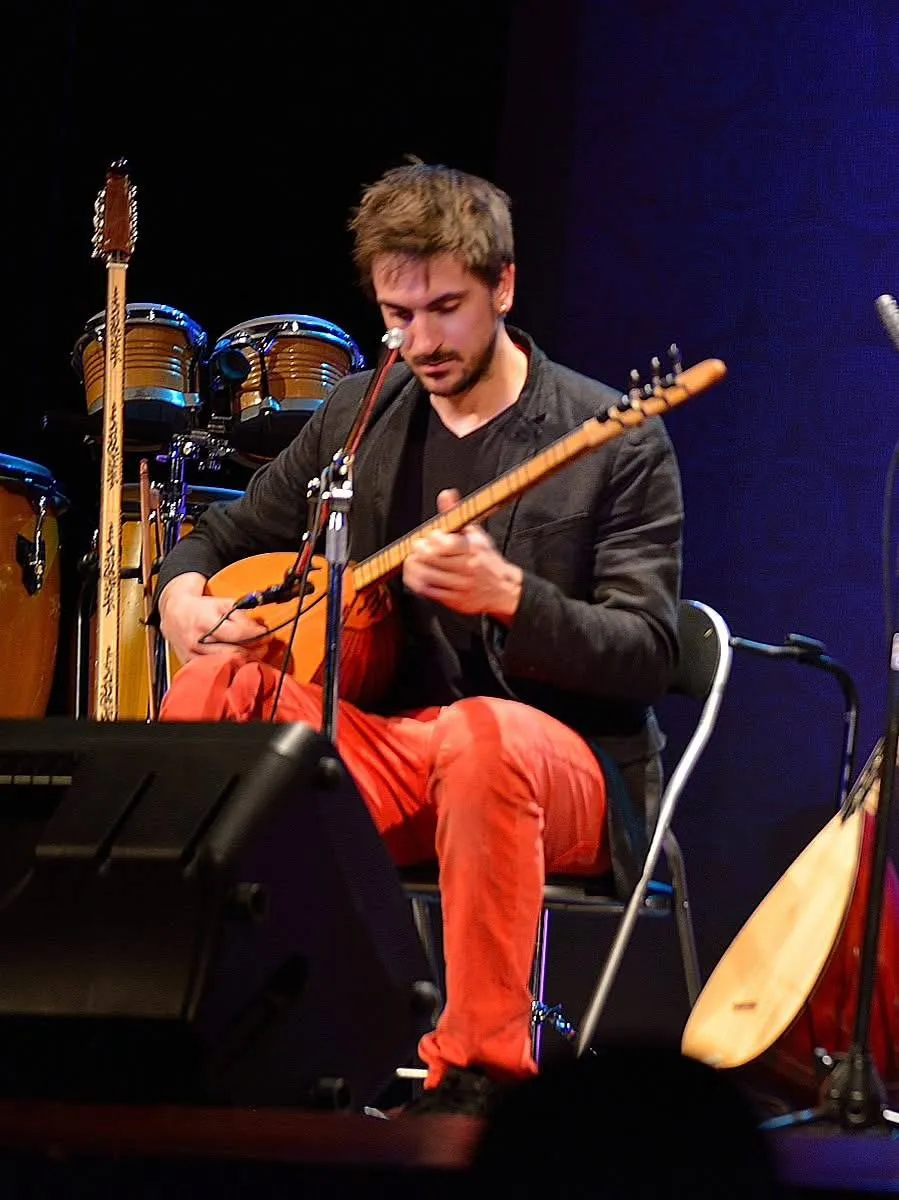
Alexánder playing bağlama with the şelpe fingerstyle technique. This is the sound, and the technique, you will be working on.

Solo bağlama with the şelpe fingerstyle technique, alongside cretan lyra. This is the technique the lessons are built around.

A zeybek — "Serenler Zeybeği" — live at Círculo de Arte, Toledo. Zeybek rhythms in 9/8 are one of the first things students ask for.

Anatolian repertoire in an ensemble, long-form, played in concert. What the instrument sounds like alongside other musicians.
What you'll learn
Turkish and Anatolian repertoire
from folk türkü to classical makam pieces.
Makam theory, made practical
intervals, seyir, and how to actually use them while playing.
Technique
mızrap/tezene plectrum work, şelpe fingerstyle, ornamentation, clean left hand.
Ear and reading
learning by ear the traditional way, plus notation when it helps.
Tuning and setup
bağlama düzeni, kara düzen, string gauges, what to do when it won't stay in tune.
Style and tradition
Anatolian, Sephardic and wider Mediterranean approaches to the same strings.
How the lessons work
- Live one-to-one video lessons over Google Meet — 60 minutes.
- Materials after every lesson: PDF scores, tabs and audio references to practise with.
- All levels — from your very first notes to advanced makam work.
- Taught in English or Spanish, whichever you prefer.
- I'm based in Spain (CET/CEST) and schedule across time zones.
- Both long-neck (uzun sap) and short-neck (kısa sap / cura) bağlama.
Your first lesson
- I listen to how you playWhatever your level, even if you started last week. Then we check your instrument: tuning and setup, acoustic or electric (elektro) saz, long-neck (uzun sap) or short-neck (kısa sap / cura).
- We sort out your materialsIf you've collected videos, books and PDFs, we decide what's worth keeping and what can wait.
- You leave with a clear planFor the next weeks: right-hand technique, tuning and positions, and two or three pieces at your level.
- Materials after the lessonPDF scores, tabs and audio references to practise with, as after every lesson.
Price
To start
Single lesson
60 minutes, one-to-one, live on Google Meet. Paid at booking.
Book a lesson — 60 €After your first lesson
Pack of 4 lessons
55 € per lesson. Four live lessons, paid now — then you book all four in the calendar.
Buy the pack — 220 €No enrolment fee. You can reschedule or cancel with a full refund up to one business day before the lesson.
Frequently asked questions
Do I need my own bağlama?
Yes, you need an instrument to practise on. But if you don't have one yet, don't buy blind — tell me your budget and where you live and I'll help you choose a good bağlama before you spend a cent. Choosing badly is the most common and most expensive beginner mistake.
I'm a complete beginner. Is that a problem?
Not at all. Most of my students started from zero, with no previous musical training. We build technique and repertoire step by step and you'll be playing real music — not exercises — from the first lessons.
Can I learn on an electric saz?
Yes. Many learners start on an electric (elektro) saz, and it is a perfectly good instrument to learn on. In the first lesson we check its setup and tuning; the technique — mızrap and şelpe — is the same as on an acoustic bağlama.
What's the difference between bağlama, saz and cura?
"Saz" is a general Turkish word for a stringed instrument; in practice it's used as a synonym for bağlama. Bağlama comes in several sizes: the long-neck (uzun sap) is the standard, the short-neck (kısa sap) is tuned higher and is common in Anatolian folk music, and the cura is the smallest and highest-pitched. I teach all of them.
Can I take lessons from Switzerland, Germany or Austria?
Yes. The lessons are online, so where you live doesn't matter. I teach students across Europe. I'm in Spain (CET/CEST), the same time zone as Zurich, Geneva, Berlin and Vienna, so scheduling is straightforward — no time difference to work around.
Do you teach in German, French or Turkish?
Lessons are taught in English or Spanish. If you're more comfortable in German, French or Turkish, write to me anyway — musical vocabulary is largely shared across these traditions and in practice it works out. Notation, tabs and recordings do a lot of the talking.
How do I pay, and is it secure?
You pay by card when you book, through Stripe. The 60 € are charged at that moment and the slot is held for you. Full refund if you cancel at least one business day in advance.
What about time zones?
I'm in Spain (CET/CEST) and teach students across Europe, the Americas and beyond. Pick any slot that suits you from the booking calendar; it shows times in your own time zone automatically.
What if I need to cancel or move a lesson?
No problem. You can reschedule or cancel free of charge, with a full refund, up to one business day before the lesson.
Are the lessons live or pre-recorded videos?
Live, always. Every lesson is a real one-to-one video call with me, adapted to what you played that week. There is no pre-recorded course here.
Book your first lesson
Pick a slot in the calendar and you're done — the 60 € are charged at booking and you'll get the Google Meet link straight away. If you'd rather ask something first, write to me and I'll reply within 24 hours.